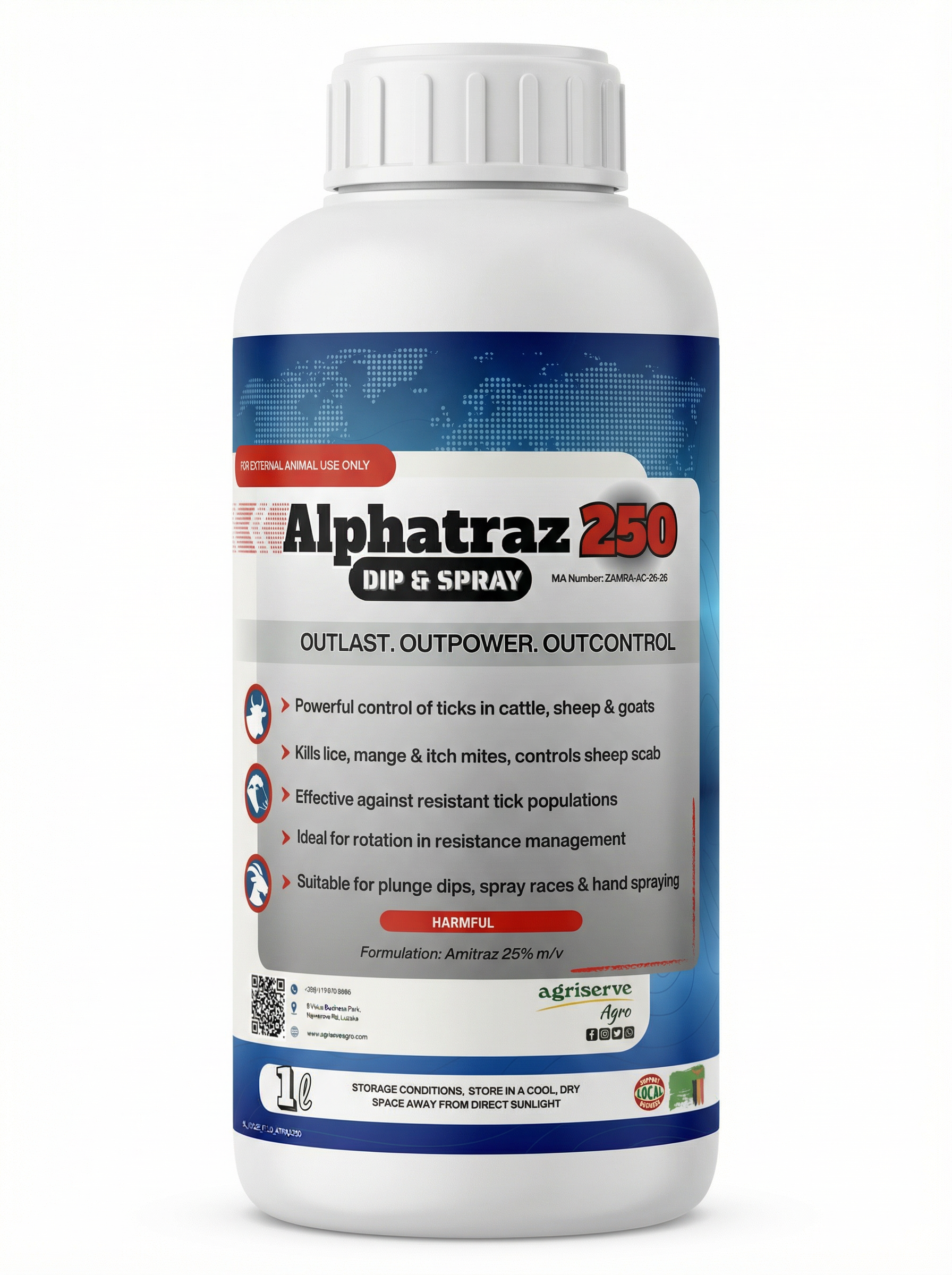
ALPHATRAZ 250
Amitraz 25% m/v
MA Number: ZAMRA-AC-26-26
Dosage & Dilution Rates
Spray Races (Cattle)
| Method | Dosage | Notes |
|---|---|---|
| Fresh fill | 1L per 1,000L water | 1:1,000 dilution |
| Replenishment | 1L per 1,000L water | 1:1,000 dilution |
| Boosting | 100ml per 100 head | Commence boosting after 500 head sprayed |
Plunge Dips (Cattle)
| Method | Dosage | Notes |
|---|---|---|
| Fresh fill | 1L per 1,000L water | 1:1,000 dilution — unstabilised |
| Total replenishment | 1L per 5,000L water | 1:5,000 — top up to volume each dipping |
Lime Stabilisation (Plunge Dips)
| Method | Dosage | Notes |
|---|---|---|
| Fresh fill | 6kg calcium hydroxide (75%) per 1,000L | Add at end of each dipping |
| Replenishment | 5kg per 100 head dipped | Maintain dipwash pH at approximately 12 |
| Extended interval (>3 weeks) | 1kg lime (75%) per 1,000L water | Protects dipwash for up to 2 months |
Hand Spraying (Cattle)
| Method | Dosage | Notes |
|---|---|---|
| Dilution | 10ml per 10L water | 1:1,000 dilution |
| Volume per animal | 5–10L dipwash per animal | Spray from below upwards to lift hair |
| Focus areas | — | Ears, under tail, tail brush, belly, legs |
Sheep & Goats (Plunge Dip)
| Method | Dosage | Notes |
|---|---|---|
| Dilution | 1L per 750L water | 1:750 — stronger than cattle rate |
| Method | 2 dippings, fresh unstabilised dipwash | OR first dip fresh, then stabilise with 4kg lime per 750L |
| Immersion | Approx. 1 minute per animal | Heads submerged at least 3 times to wet inside of ears |
| Sheep scab / goat mange | 2 dippings, 7 days apart | At 1:750 dilution — kills scab, itch & mange mites |
Dilution Calculator
Calculate the exact amount of ALPHATRAZ 250 needed for your dip tank, spray race, or hand spraying operation.
Premixing Step: Always add the measured volume of ALPHATRAZ 250 to double that volume of water (while stirring) to form a creamy emulsion before adding to the dip tank.
Always confirm dilution rates with the product label. Do not mix Alphatraz 250 with any other dip product.
Recommended Dipping Intervals
| Condition | Recommended Interval |
|---|---|
| Ticks and mange (cattle) | Spray or dip weekly |
| Lice (cattle) | Spray or dip twice with a 7-day interval |
| Sheep scab, itch & goat mange mites | 2 dippings, 7 days apart at 1:750 |
| Dipwash shelf life (unstabilised) | Use within 3 days — discard any remaining solution |
Withdrawal Periods
Directions for Use
Shake well before use. Protect from extremes of heat, cold and dampness.
Premixing: Add a measured volume of concentrate to approximately 10L water in a suitable container. Mix well, then add to the measured bulk water in the spray sump or dip tank. Stir thoroughly.
Dipwash should be freshly prepared for each spraying session.
Do not mix Alphatraz 250 with any other dip.
For hand spraying, thoroughly wet the animal by spraying from below upwards so that the hair is lifted by the spray. Concentrate on the ears, under the tail and in the brush of the tail.
Special Management Guidelines
Spray Race Best Practice: It is recommended that not more than 500 head be sprayed at one time, particularly where fouling is a problem. Where this figure is exceeded, boost at 100ml per 100 head to maintain satisfactory active ingredient deposit.
Plunge Dip Replenishment: Top up the dip tank to the desired level before each dipping. Add Alphatraz 250 at 1L per 5,000L water on every occasion, taking the total volume of water in the tank into calculation.
Lime Stabilisation: For plunge dips, add 6kg calcium hydroxide (75%) per 1,000L water at fresh fill. At replenishment, add 5kg per 100 head dipped to maintain pH at approximately 12. If dipping intervals exceed 3 weeks, add 1kg lime per 1,000L to protect the dipwash for up to 2 months.
Sheep & Goat Immersion: Ensure animals are immersed for approximately 1 minute with heads submerged at least 3 times to thoroughly wet the inside of the ears.
Post-Dipping Lameness Prevention (Sheep): To control bacterial build-up and prevent post-dipping lameness, add copper sulphate at 500g per 1,000L water OR zinc sulphate at 1kg per 1,000L dipwash. For post-dipping lameness and lumpy wool control, add zinc sulphate at 1kg per 400L dipwash.
Sheep Scab: Sheep scab is a notifiable disease. Treatment of suspected or confirmed outbreaks must be under government supervision.
Dipwash Shelf Life: Once prepared, the dip tank or spray solution should be used within 3 days. Any solution remaining thereafter should be discarded.
Tick-Borne Disease Immunity
Important Advisory: Effective dipping may in time give rise to very low tick infestations. This could adversely affect immunity to tick-borne diseases, especially in young stock. It is therefore advisable that animals be immunised against tick-borne diseases. If this is not possible, young stock under 4 weeks should not be dipped unless tick infestation is excessive.
Precautions
First Aid
Should accidental poisoning or contact occur, wash well with soap and water. In case of poisoning, call a doctor and make this label available. Note to practitioner: Treat symptomatically.