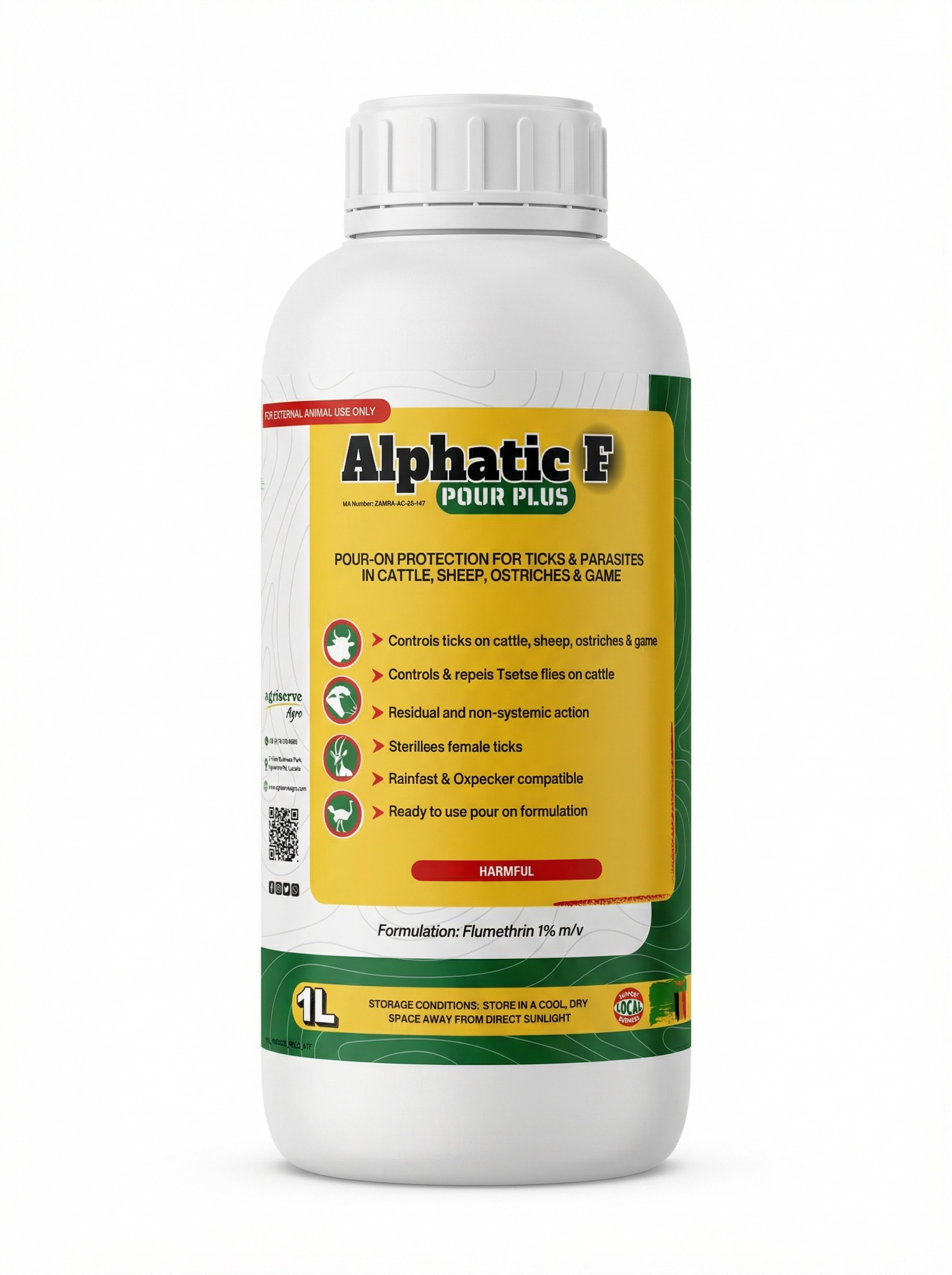
ALPHATIC F POUR PLUS
Flumethrin 1% m/v
MA Number: ZAMRA-AC-25-147
P/L No: ZAMRA-PHAR/MAN-25-0069
Dosage & Dilution Rates
Dosage Table — Cattle & Game
| Method | Dosage | Notes |
|---|---|---|
| Up to 100 kg | 1 ml per 10 kg body mass | Use dosemeter |
| 100 kg | 10 ml | 100 doses per 1L |
| 200 kg | 20 ml | 50 doses per 1L |
| 300 kg | 30 ml | 33 doses per 1L |
| 400 kg | 40 ml | 25 doses per 1L |
| 500 kg+ | 50 ml | 20 doses per 1L |
Dosage Table — Sheep & Ostriches
| Method | Dosage | Notes |
|---|---|---|
| 20 kg | 2 ml | 500 doses per 1L |
| 30 kg | 3 ml | 333 doses per 1L |
| 40 kg | 4 ml | 250 doses per 1L |
| 50 kg | 5 ml | 200 doses per 1L |
| 60 kg | 6 ml | 166 doses per 1L |
Dosage Calculator
Enter the average body weight and number of animals to calculate the required dose of ALPHATIC F POUR PLUS.
Based on the dosage rate of 1 ml per 10 kg body mass. Always confirm dosage with the product label.
Recommended Treatment Intervals
| Condition | Recommended Interval |
|---|---|
| General tick control | Treat at regular intervals according to tick challenge |
| Tsetse fly worry (cattle) | Every 14 days or according to challenge |
| Karoo paralysis tick (sheep) | 2–3 treatments, 7–10 days apart, early in season |
| Reduced tick pressure | Treatment intervals may be extended beyond 7 days |
Withdrawal Periods
Directions for Use
Shake well before use.
Use only as directed. Treat animals at regular intervals according to tick challenge.
The basic dosage is 1 ml per 10 kg body mass. Regular application progressively reduces the tick population.
Cattle: Apply the required dose in two lines, from the base of the skull along both sides of the spine up to the tail root.
Sheep: Apply the required dose volume in four parts to the bare skin areas of the groin and axillae.
Ostriches: Apply the required dose volume along the backline.
Game: Apply the required dose volume with a suitable pour-on applicator.
Applicator: Squeeze bottle with dosemeter. Squeeze required volume into dosemeter.
Special Management Guidelines
Karoo Paralysis Prevention (Sheep): Apply Alphatic F Pour Plus early in the season, as soon as Karoo paralysis ticks (Ixodes rubicundus) are first observed on the grazing or on the animals. Two to three treatments 7–10 days apart should provide protection, depending on the severity of the tick challenge.
Self-Medicating Devices (Game): If a self-medicating device is used, ensure the device remains activated only long enough to deliver a single dosage to all animals in the camp/paddock. Do not leave the device activated for continuous low-level treatment.
Young Stock: Not recommended for very young lambs or calves unless infestation is severe.
Avoid treating animals during the heat of the day to reduce the risk of skin irritation.
Regular application progressively reduces the tick population. Once tick pressure decreases, treatment intervals may be extended beyond 7 days, depending on field conditions.
Tick-Borne Disease Immunity
Important Advisory: Correct, regular treatment may reduce natural exposure to ticks and may affect tick-borne disease immunity, especially in young animals. Seek veterinary advice where tick-borne diseases are prevalent. Young stock under 4 weeks should not be treated unless infestation is severe. Where possible, vaccinate against tick-borne diseases.
Precautions
First Aid
If swallowed, do not induce vomiting. Seek medical attention immediately. If skin contact occurs, wash thoroughly with soap and water. If eye contact occurs, rinse with clean water for at least 15 minutes. In all cases of suspected poisoning, consult a doctor and make this label available.