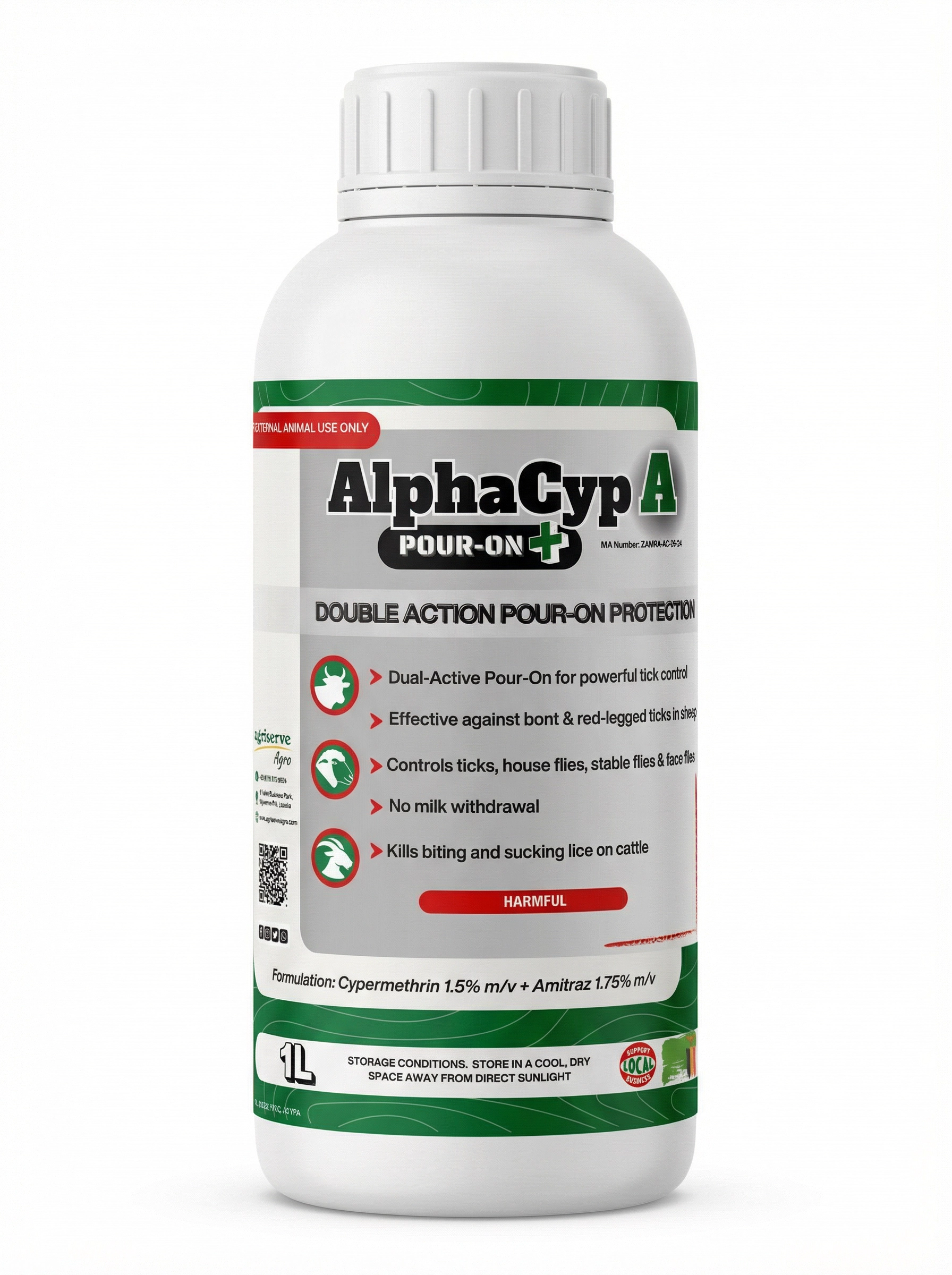
ALPHACYP A POUR+
Cypermethrin 1.5% m/v + Amitraz 1.75% m/v
MA Number: ZAMRA-AC-26-24
Dosage & Dilution Rates
Cattle Dosage — 1ml per 10kg Body Mass
| Method | Dosage | Notes |
|---|---|---|
| 50 kg | 5 ml | Doses per 1L: 200 | per 5L: 1,000 |
| 100 kg | 10 ml | Doses per 1L: 100 | per 5L: 500 |
| 200 kg | 20 ml | Doses per 1L: 50 | per 5L: 250 |
| 300 kg | 30 ml | Doses per 1L: 33 | per 5L: 166 |
| 400 kg | 40 ml | Doses per 1L: 25 | per 5L: 125 |
| 500 kg (+) | 50 ml | Doses per 1L: 20 | per 5L: 100 |
Sheep & Goats Dosage — 1ml per 5kg Body Mass (2ml per 10kg)
| Method | Dosage | Notes |
|---|---|---|
| 20 kg | 4 ml | Doses per 1L: 250 | per 5L: 1,250 |
| 30 kg | 6 ml | Doses per 1L: 166 | per 5L: 833 |
| 40 kg | 8 ml | Doses per 1L: 125 | per 5L: 625 |
| 50 kg | 10 ml | Doses per 1L: 100 | per 5L: 500 |
| 60 kg | 12 ml | Doses per 1L: 83 | per 5L: 416 |
| 80 kg (+) | 16 ml | Doses per 1L: 62 | per 5L: 312 |
Dosage Calculator
Enter the average body weight and number of animals to calculate the required dose of ALPHACYP A POUR+.
Based on the dosage rate of 1 ml per 10 kg body mass (Cattle). Always confirm dosage with the product label.
Recommended Treatment Intervals
| Condition | Recommended Interval |
|---|---|
| Ticks on cattle (initial treatment) | Weekly for 3 weeks |
| Ticks on cattle (maintenance) | Repeat according to tick challenge |
| Tsetse flies on cattle | Every 14 days according to fly challenge |
| Sheep and goats (general) | Treat twice, 3 weeks apart |
| Karoo paralysis tick (sheep) | 2–3 treatments, 7–10 days apart |
Withdrawal Periods
Directions for Use
Shake well before use.
Use only as directed. Treat animals at regular intervals, according to tick challenge.
Cattle: Apply the calculated dose along the spinal column from the poll of the head to the tail root in a single midline. Use a suitable pour-on applicator for accurate dosing.
Sheep & Goats (Karoo paralysis tick): Apply approximately a quarter of the dose in each of the four axillae (armpits) and groin areas.
Sheep & Goats (red lice): Apply the full dose as a stripe down the midline of the back.
For tsetse flies, treat every 14 days according to fly challenge.
Regular application progressively reduces the tick population. Once tick pressure decreases, treatment intervals may be extended beyond 7 days depending on field conditions.
Special Management Guidelines
Calves under 6 months of age must be treated strictly according to body mass — do not exceed the recommended dose rate.
Do not mix Alphacyp A Pour+ with any other product.
Individual animals may show signs of salivation after treatment. This is transient and will pass with no ill effect.
Signs of salivation and lethargy may occur with overdosage. These signs are transient and will pass with no ill effect.
Avoid treating animals during the heat of the day to reduce risk of irritation.
Tick-Borne Disease Immunity
Important Advisory: Correct, regular treatment may reduce natural exposure to ticks and may affect tick-borne disease immunity, especially in young animals. Seek veterinary advice where tick-borne diseases are prevalent. Where possible, vaccinate animals against tick-borne diseases.
Precautions
First Aid
In case of accidental poisoning or ingestion, consult a medical practitioner immediately and make this label available. No specific antidote — treat symptomatically. If skin contact occurs, wash thoroughly with soap and water.